
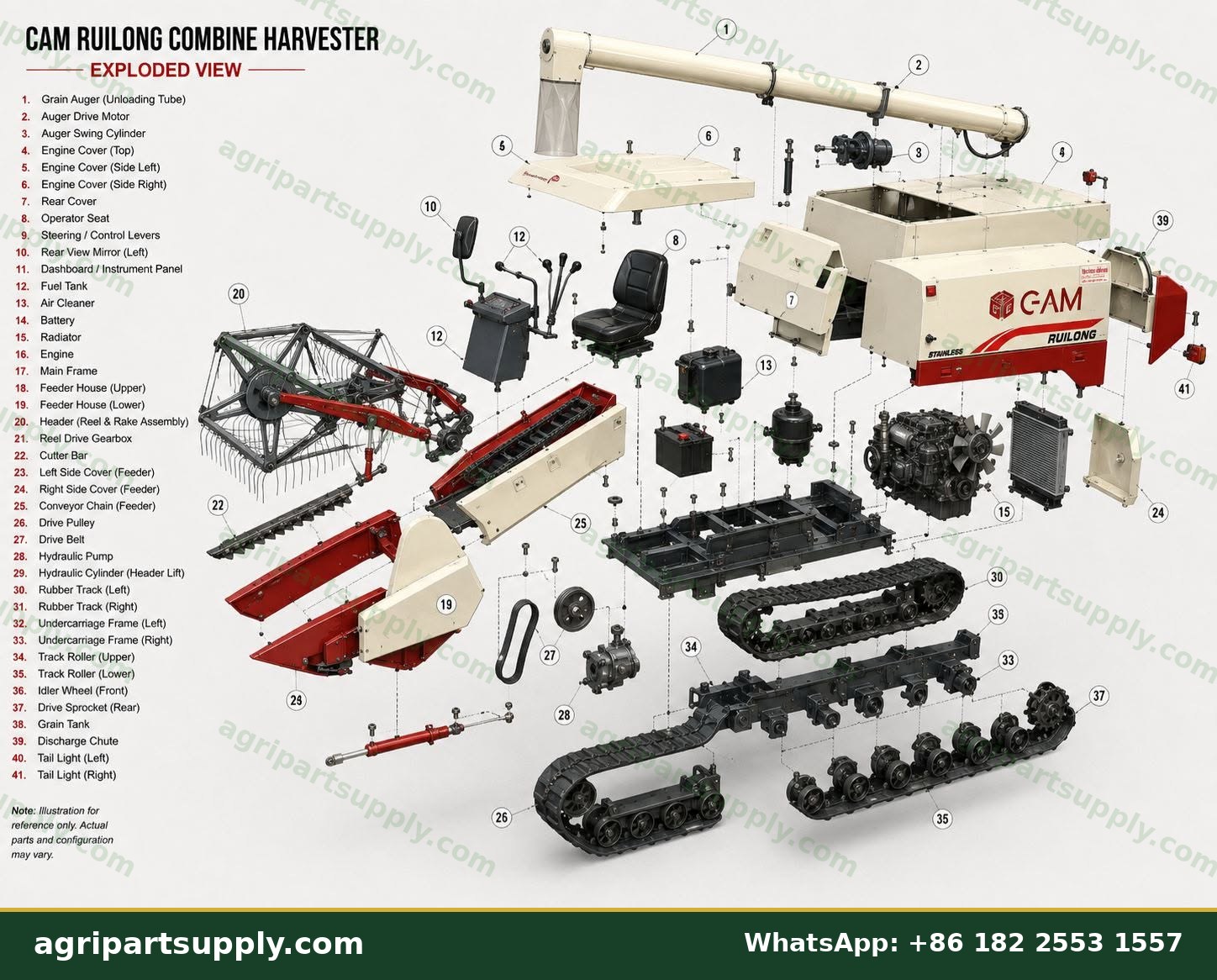
A self-propelled combine harvester is one of the most densely packed machines a farmer or dealer will ever service. Several hundred parts are squeezed into a frame that cuts, feeds, threshes, cleans and unloads grain in a single pass. When something fails mid-season, the hardest part is rarely the repair — it is putting the correct name and part number to the broken piece. This guide uses an exploded view of a World Ruilong–platform machine to walk every B2B buyer through the assemblies, the fast-moving wear parts, and exactly what to order.
The drawing below is built on the FM World 4LZ (Wode Ruilong) platform — the same line sold in Indonesia as the Maxxi Bimo 102 (4LZ-6.0P) and Bimo 88 (4LZ-4.0E). The layout and part groups are almost identical across Kubota, Lovol, Yanmar and Zoomlion track combines, so the same logic applies to any brand in your fleet.
From front to back: the working groups of a combine
1. Header and reel (20–22) — the cutting front
The header is the first point of contact with the crop. 20 is the header assembly with the reel and rake, which lifts lodged rice and feeds it to 22 the cutter bar; 21 is the reel drive gearbox. The cutter bar — knife sections, knife guards (called kuku macan in Indonesia) and the ledger plates that hold them — is the single most frequently replaced component on the front. A broken knife guard or a chipped section raises shatter loss within hours. For a full breakdown of the cutting front, see the header parts and how they work guide.
2. Feeder house (18, 19, 23, 24, 25) — crop elevator
The upper (18) and lower (19) feeder houses form the inclined conveyor that carries cut material into the rotor. Side covers 23/24 keep dust out, while 25 the feeder (conveyor) chain pulls the slats. Feeder chains stretch, slat pins wear and flighting hooks snap under heavy, wet straw — all are normal seasonal replacements rather than failures.
3. Threshing, separating and cleaning — inside the rotor body
The largest cover on the machine hides the threshing drum, rasp bars, concave, straw walkers, sieves, cleaning fan and cross augers. These are the parts that decide grain loss and sample quality. Rasp bars beat the grain out of the heads, the concave sets the clearance, and the sieve (ayakan) plus blower separate grain from chaff. We cover part-by-part diagnosis and clearances in the threshing and cleaning system guide — these components are the highest-volume after-sales category after the cutter bar.
4. Grain unloading (1, 2, 3, 38, 39) — getting grain to the truck
1 is the unloading grain auger (the swing-out tube), driven by 2 the auger drive motor/cylinder and turned by 3 the auger swing cylinder. Clean grain is held in 38 the grain tank and reaches the truck through 39 the discharge chute. The auger flighting (the spiral on the shaft) and the unloading tube liners wear from abrasion; a bent auger or worn shaft seal will spill grain or jam the swing.
5. Engine and power (12–16, 26, 27) — the heart of the machine
Under the top and side engine covers (4, 5, 6) sit 16 the diesel engine, 15 the radiator, 13 the air cleaner, 14 the battery and 12 the fuel tank. Power reaches the working parts through 26 the drive pulley and 27 the drive belt. Filters, the radiator, fan belts, the battery and the alternator are routine service items; main engine internals such as the piston and turbo are ordered by exact OEM part number.
6. Tracks and undercarriage (30–37) — ground contact in mud
Rubber tracks 30/31 wrap around left and right undercarriage frames 32/33. Each side runs on upper and lower track rollers 34/35, is tensioned by the front idler wheel 36 and driven by the rear drive sprocket 37. In deep, wet Indonesian paddy fields, track rollers, their seals and the idler are worked continuously — this is the classic field-season breakdown. Browse the full chassis and track components range by machine.
7. Hydraulics (28, 29) — lifting and steering
28 the hydraulic pump supplies pressure to 29 the header-lift cylinder and the auger swing cylinder (3). Oil seals, O-rings, the pump and cylinder rods are the common leak points; a drifting header is almost always a seal or relief-valve issue rather than a bent part.
8. Operator station and body (4–11, 40, 41) — control and protection
The operator seat 8, steering/control levers 9, mirror 10 and instrument panel 11 form the cab; rear cover 7, side covers and tail lights 40/41 finish the body. These are slower-moving, but damaged panels and lights are frequently needed after transport accidents.
Which parts actually fail first?
For a dealer, the 80/20 of combine harvester spare parts is very clear. Stock and order these first:
- Cutter bar: knife sections, knife guards / kuku macan, hold-down clips, ledger plates;
- Feeder & threshing: feeder chains, slats, rasp bars, concave bars, sieves, cleaning auger flighting;
- Undercarriage: track rollers, idler and drive sprocket, rubber tracks, track seals;
- Power & drives: V-belts, pulleys, bearings, oil seals, fuel/oil/air filters;
- Unloading: auger flighting and shaft seals.
Use these groups to build a season-start kit rather than buying one piece at a time; the symptoms and replacement intervals are listed in the when-to-replace wear parts guide.
How to order from the drawing
You do not need perfect English to order the right part. Send the machine brand and model (for example Bimo 102 / 4LZ-6.0P), the part number from the plate, and the quantity — or simply send a photo of the broken piece with the numbered drawing. One parts list returns one consolidated quote, with original, high-grade and economy tiers available for the fast-moving items. Stock is held for common cutter, track, belt and filter parts so repeat orders ship quickly.
Need the full part-number catalog?
Brand-specific catalogs for FM World, Kubota, Lovol, Yanmar and Zoomlion — with exploded views and official part numbers — are available on the parts catalog download page. For the complete FM World / Bimo program, start with the FM World (Bimo 102 / Bimo 88) parts range, then send your numbered list for a single quotation.